

guide
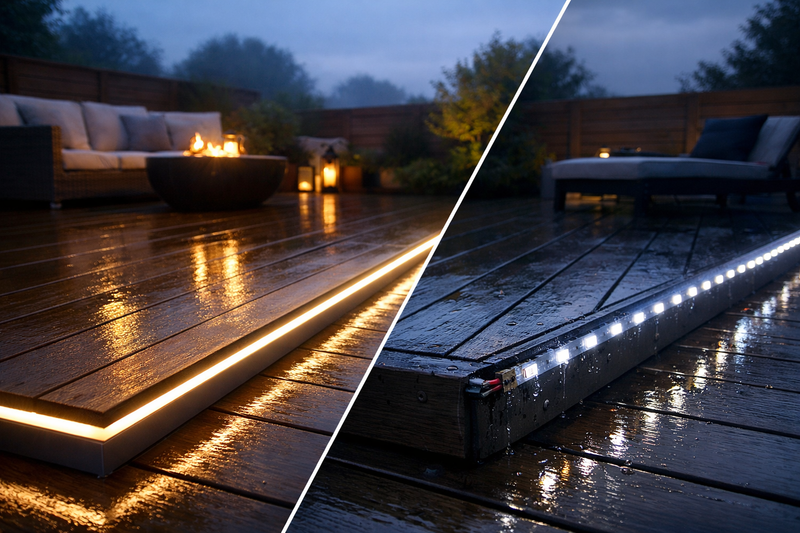
How to Install LED Decking Lights: The Complete Outdoor Installation Guide (2026)
Your decking is laid, the barbecue is ready, and you want lighting that lasts more than one British winter. Most outdoor LED installations fail within 12 months — not because the lights are bad, but because the installation is wrong. Incorrect IP ratings, exposed cut ends, drivers sitting in drainage paths, and PVC jackets that crack at the first hard frost account for the majority of outdoor LED failures across the UK. This is the hands-on installation guide for anyone fitting LED decking lights in 2026. Whether you are a homeowner tackling a weekend project, a landscape gardener adding lighting to a client build, or an electrician crossing into outdoor LED work for the first time, this guide covers every step from planning through to first switch-on and annual maintenance. We focus on LED neon flex for decking, outdoor-rated COB strip, and recessed options — with specific methods for both timber and composite boards, UK wiring compliance, and the sealing techniques that separate a five-year installation from a one-season failure. IP67+ rated · 24V & 48V options · FreeCut at any point · UV-stable silicone · 5-year warranty · Free UK delivery Quick decision summary: If you need edge lighting around a standard 4x3m deck, use 6x12mm IP67 neon flex in an aluminium mounting profile, powered by a 24V driver with 20% wattage headroom, housed in an IP65 enclosure under the deck. If your deck perimeter exceeds 15 metres or you are running multiple zones, step up to 48V to halve voltage drop. If you have standing water or coastal exposure, use IP68-rated product throughout. Who this guide is for: Homeowners fitting decking lights on timber or composite decking. Landscape gardeners and deck builders adding lighting to new or existing builds. Electricians and contractors new to outdoor LED strip and neon flex installation. Property developers adding outdoor lighting to increase kerb appeal. Who this guide is NOT for: If you are looking to choose which decking lights to buy rather than how to install them, read our LED neon flex decking lights buying guide instead. If you need general indoor LED strip installation advice, see our complete LED strip installation guide. Common installation mistakes to avoid in 2026: Using IP65-rated strip outdoors: IP65 is rated for surface splash only. In a typical British winter with frost-thaw cycling, rain, and standing moisture, IP65 strip fails within 6–12 months as water wicks through the coating and corrodes solder joints. Use IP67 minimum for any permanent outdoor installation. Leaving cut ends unsealed: Every cut end is an open channel for water to travel along the inside of the strip or neon flex tube. One unsealed end can destroy an entire 5-metre run within weeks of rain exposure. Use the three-layer seal: self-amalgamating silicone tape, heat-shrink tubing, and an IP-rated end cap. Mounting the driver in a drainage path under the deck: Raised decks channel rainwater into predictable drainage paths. If your driver or junction box sits in one of these paths, standing water pools around it. Mount the driver elevated on a joist, in a ventilated IP65 enclosure, with drip loops on all cable entries. Adhesive-mounting strip directly onto timber or composite: Without a heat sink, LED junction temperatures climb during summer evenings, accelerating phosphor degradation. Use aluminium profiles with mechanical brackets — they conduct heat away from the LEDs and survive the vibration of foot traffic overhead. Running a 24V driver on a 20m+ perimeter without checking voltage drop: At 24V, visible voltage drop starts at approximately 10 metres and becomes unacceptable by 20 metres. For perimeters over 15 metres, use 48V — voltage drop occurs at half the rate at equivalent power. Jump to section: Tools and materials needed Neon flex vs COB strip vs recessed — which works best? What IP rating do you actually need in the UK? Planning your decking lighting layout Composite vs timber installation differences Routing cables safely under a deck Where to mount the LED driver outdoors Cutting and sealing outdoor LED strip and neon flex Step-by-step: installing neon flex along decking edges Step-by-step: fitting LED strip in aluminium profiles on a deck Connecting multiple LED runs on a large deck Waterproofing every connection point outdoors What wattage driver do you need? 24V or 48V for a large deck perimeter? The most common outdoor LED decking installation mistakes Maintaining outdoor decking lights year after year Part P Building Regulations and decking lights Frequently asked questions What tools and materials do you need to install LED decking lights? A complete LED decking light installation requires standard DIY tools plus several specialist items: a multimeter for voltage testing, wire strippers rated for fine-gauge cable, IP-rated junction boxes for outdoor connections, self-amalgamating silicone tape for sealing cut ends, and a cordless drill with both wood and masonry bits for mounting profiles and routing cable clips. Before you start, lay out every tool and material on a dry surface. Checking you have everything before lifting a single decking board saves hours of mid-project trips to the hardware shop. The list below covers a typical 4x3m deck with edge lighting on three sides — scale up quantities for larger projects. Essential tools Cordless drill/driver: For pre-drilling profile mounting holes and securing cable clips to joists. Use a 2mm pilot bit for hardwood and composite, 3mm for softwood. Wire strippers: Rated for 0.5mm to 1.5mm cable. LED low-voltage cable is typically 0.75mm or 1.0mm twin-core. Multimeter: Essential for checking voltage at the strip end after installation. A reading below 90% of rated voltage indicates excessive voltage drop and requires rewiring or a thicker cable gauge. Sharp scissors or side cutters: For cutting neon flex and COB strip at marked cut points. Blunt cuts crush the silicone jacket and compromise the seal. Heat gun: For shrinking heat-shrink tubing over sealed connections. A hairdryer is not hot enough — you need 200-300 degrees Celsius. Spirit level (600mm minimum): For ensuring profiles run level along the deck fascia. Uneven profiles create visible light gaps. Tape measure and pencil: Mark all cut points, cable entry holes, and profile positions before committing to any cuts. Jigsaw or oscillating multi-tool: For cutting channels in fascia boards or notching joists for cable routing, if required by your layout. Essential materials LED neon flex or outdoor COB strip: IP67 minimum for all permanent UK outdoor installations. IP68 if the strip will sit at ground level or in areas prone to standing water. Browse IP67 neon flex or IP68 neon flex options. Aluminium mounting profiles: Required for COB strip installations outdoors. Also recommended for neon flex on composite decking where adhesive alone is unreliable. See neon flex profiles and LED strip profiles. LED driver (power supply): Correctly sized for total wattage plus 20% headroom. Constant voltage, non-dimmable for RGB/RGBW; trailing-edge dimmable compatible for single-colour. IP65+ driver enclosure: If the driver must be located outdoors. Never leave a non-IP-rated driver exposed, even under a deck. IP68 junction boxes: For all outdoor wire-to-wire connections. Standard chocolate-block connectors corrode within months outdoors. Self-amalgamating silicone tape: For sealing cut ends and connection points. This is not electrical tape — it fuses to itself and creates a waterproof bond. Heat-shrink tubing (adhesive-lined): 3:1 shrink ratio, applied over connections before the self-amalgamating tape layer. IP-rated end caps: Specific to your neon flex or strip profile. Every cut end must be capped. Outdoor-rated twin-core cable: 0.75mm minimum for short runs under 5m. Step up to 1.5mm for runs over 10m or where the cable crosses joists. Cable conduit or trunking: Required for any cable run crossing a joist or running through a structural member. Stainless steel screws: For mounting profiles and cable clips. Standard zinc-plated screws corrode in outdoor conditions within one to two seasons. Cable clips (UV-rated): Standard white cable clips become brittle in UV exposure. Use black UV-stabilised clips or stainless steel P-clips. Which type of LED light works best for outdoor decking — neon flex, COB strip, or recessed? For most UK deck installations in 2026, IP67 LED neon flex provides the best combination of weather resistance, even light output, and installation simplicity. COB strip in aluminium profiles suits flush-mounted applications where the profile can be recessed into the fascia. Recessed deck lights create spot-lit pools rather than continuous edge glow. The right choice depends on the visual effect you want, the deck construction, and how much installation complexity you are prepared to handle. Neon flex wraps around corners, bends through curves, and produces a smooth, dot-free glow without requiring a separate diffuser. COB strip offers higher lumen output per metre but requires an aluminium profile with a diffuser cover to protect it outdoors and to prevent individual LED hotspots. Recessed puck-style lights are a different category entirely — they require drilling large holes through deck boards and are best suited to stairways and pathway marking rather than perimeter lighting. Feature LED neon flex COB strip in profile Recessed deck lights Light effect Continuous smooth glow, dot-free Continuous bright line (with diffuser) Individual pools of light IP rating available IP67, IP68 IP20 strip + IP65/IP67 profile Typically IP65 or IP67 Ease of installation High — mount in profile or clip directly Medium — requires profile, diffuser, end caps Low — requires hole saw, wiring per unit Profile required? Optional (recommended for composite) Required for outdoor use Self-contained housing Cut flexibility Every 25–50mm (FreeCut on ATOM LED) Every 25–100mm depending on model Not cuttable — fixed units Best use case Perimeter edge glow, step nosing, curves Under-rail lighting, fascia recess, straight runs Stairway marking, pathway dots Approximate cost per metre (2026) £8–£18 (strip only) £12–£25 (strip + profile) £8–£15 per unit (300mm spacing typical) Maintenance Low — sealed unit, wipe clean Medium — diffuser may need re-seating Low — but replacement means lifting boards For a standard UK residential deck with perimeter edge lighting, neon flex is the default recommendation in 2026. The 6x12mm slim profile fits into the gap between fascia board and deck surface on most standard builds. If you need higher brightness — for example, lighting a large entertaining area or a commercial terrace — COB strip in a recessed aluminium profile delivers more lumens per metre, but requires more installation effort and careful waterproofing at every joint. What IP rating do outdoor decking lights actually need in the UK? Any LED lighting permanently installed outdoors in the UK requires a minimum IP67 rating. IP65 is rated for surface splashing only and fails within one winter from frost-thaw moisture ingress. IP67 handles temporary immersion and year-round UK weather. IP68 is required for ground-level installations, standing water areas, or coastal locations with salt spray exposure. This is the single most common mistake in outdoor LED installations across the UK: using IP65-rated strip because the listing says "waterproof." IP65 means protected against water jets from any direction — which sounds adequate until you consider what a British winter actually does to a decking installation. Water does not just splash your deck lights; it pools around fixings, freezes inside micro-gaps, and wicks along cut ends through capillary action. Each freeze-thaw cycle forces water deeper into the strip or neon flex jacket. By spring, IP65-rated products typically show condensation behind the lens, darkened LEDs, and in many cases complete circuit failure. IP rating What it means UK outdoor suitability Typical failure timeline outdoors IP65 Protected against water jets from any direction NOT suitable for permanent outdoor use in UK climate 3–12 months. Frost-thaw cracks jacket, moisture enters through cut ends and connector joints. IP67 Protected against temporary immersion (up to 1m for 30 minutes) Standard for most UK outdoor decking installations 5+ years with correct installation and annual inspection. IP68 Protected against continuous submersion Required for ground-level, standing water, pond surrounds, coastal 7+ years. Full silicone encapsulation resists salt, UV, and continuous moisture. IP69 Protected against high-pressure, high-temperature wash-down Commercial kitchens, food processing — rarely needed for decking 10+ years in appropriate application. The material matters as much as the rating. A PVC-jacketed neon flex rated IP67 will still crack in sustained sub-zero temperatures because PVC becomes rigid and brittle below approximately 0 degrees Celsius. Silicone-jacketed products maintain flexibility from -40 degrees Celsius to +200 degrees Celsius. In the UK, where overnight temperatures can drop to -10 degrees Celsius in a hard winter and then climb to +30 degrees Celsius the following summer, silicone is the only jacket material that survives long-term without hardening, yellowing, or cracking. ATOM LED uses UV-stable silicone across its outdoor neon flex range for exactly this reason. How do you plan a decking lighting layout before installation? Start with a scaled sketch of your deck showing exact dimensions, board direction, joist positions, and the location of the nearest power source. Mark every lighting run, driver position, cable route, and connection point before purchasing materials. A 30-minute planning phase prevents the most expensive installation mistakes — buying too little strip, routing cables through drainage paths, or placing the driver where water collects. Measure the total length of every edge you want to light. Add 10% to account for corners, bends, and wastage from cut-point alignment. LED neon flex and COB strip can only be cut at specific marked intervals — typically every 25mm to 50mm — so your measured run will almost never divide perfectly into the strip's cut points. Planning checklist Measure every lighting run: Use a tape measure along the actual mounting surface, not a straight-line calculation. Fascia boards often have slight bows. Record each run length separately. Identify your power source: Where is the nearest outdoor socket or fused spur? The cable run from driver to strip should be as short as practical — every metre of cable adds voltage drop. Map the joist layout: If you need to run cables under the deck, you need to know where the joists are. Joists determine where you can drill or notch for cable routing. Mark the driver location: Choose a position that is elevated, ventilated, sheltered from direct rain, and not in a water drainage path. Inside the house or garage is ideal if the cable run permits. More detail in Section 7. Plan connection points: Every junction between cable and strip, or between two strip lengths, is a potential failure point outdoors. Minimise the number of connections. Where connections are unavoidable, locate them in accessible positions — not buried behind boards you cannot remove. Check drainage paths: Pour water on your deck and watch where it flows underneath. Raised decks create a cavity that channels rainwater to low points. If your planned driver or junction box position sits in a drainage path, relocate it now. Calculate total wattage: Add up the wattage-per-metre of every strip run. Add 20% headroom. This gives you your minimum driver size. See Section 13 for the full calculation method. Consider zones and controls: If you want some areas on dimmers and others at full brightness, plan separate driver and controller circuits from the start. Retrofitting zones is expensive and disruptive. Seasonal timing matters. The best months for outdoor LED decking installation in the UK are April, May, September, and October. Installing in summer heat (above 28 degrees Celsius) softens adhesive tape and causes it to slip before it bonds. Installing in winter risks working with cold-stiffened cables, frozen ground, and adhesive that will not cure. Mid-spring and early autumn give you workable temperatures (10-22 degrees Celsius) and enough daylight to complete a typical installation in a single day. Does composite decking need different installation to timber? Yes. Composite decking expands and contracts significantly more than timber — typically 3 to 5mm per 3-metre board length across a full seasonal cycle, compared with 1 to 2mm for pressure-treated softwood. This affects mounting method, screw selection, adhesive suitability, and the gap dimensions that lighting must fit within. Treating composite the same as timber is a common cause of profile buckling and adhesive failure. The core issue is thermal expansion. Composite boards — whether capped polymer (Trex, TimberTech), mineral-filled (Millboard), or standard wood-plastic composite — absorb and retain heat differently from natural timber. On a south-facing deck in July, composite surface temperatures can reach 55-60 degrees Celsius, compared with 35-40 degrees Celsius for timber. This heat affects everything from adhesive bond strength to the dimensional gap between your fascia and deck surface. Factor Timber decking Composite decking Seasonal expansion (per 3m board) 1–2mm 3–5mm (up to 7mm for dark colours) Recommended mounting method Adhesive-backed profiles or direct screw-fix Mechanical screw-fix through profiles only — adhesive alone fails Screw type Stainless steel 3.5x25mm with pilot hole Stainless steel composite deck screws with under-cut head. Pilot hole mandatory. Expansion gap at joints 2–3mm between boards typical 5–8mm between boards (manufacturer specified) Surface heat retention Moderate (35–40 degrees Celsius peak) High (55–60 degrees Celsius peak, dark colours higher) Adhesive suitability VHB tape bonds well to clean, dry timber VHB tape fails in heat cycles — use mechanical fixing as primary, adhesive as secondary Profile fixing method Pre-drill 2mm pilot, screw at 300mm intervals Pre-drill 2.5mm pilot through profile and board, screw at 200mm intervals to resist expansion forces Neon flex clip spacing Every 250–300mm Every 150–200mm to prevent the strip lifting as gaps open and close The practical difference: On timber, you can often mount a slim aluminium profile along the fascia using adhesive backed with screws at 300mm centres. On composite, adhesive alone will peel away within two summer-winter cycles as the board expands and contracts beneath it. Use screws as the primary fixing at 200mm centres, with adhesive serving only as an anti-rattle measure between screws. Always pre-drill composite — it does not accept self-tapping screws cleanly and will mushroom around the entry point. How do you route cables safely under a deck? Cable routing under a deck must protect the cable from physical damage, moisture, and rodent interference. Use UV-rated conduit or armoured cable for any run crossing a joist or spanning more than 1 metre unsupported. All cables should run along the side of joists — never across the top surface where foot traffic loads compress the deck boards down onto them. Leave drip loops at every entry and exit point to prevent water tracking along the cable into an enclosure. Under-deck cable routing is where most DIY installations cut corners. A bare twin-core cable clipped loosely under the deck will work for the first year. By year two, UV degradation has made the outer sheath brittle, moisture has found every nick in the insulation, and you have a fault that is almost impossible to trace without lifting multiple boards. Cable routing best practice — step by step Plan the route on paper first: Draw the joist layout and mark the cable path. The shortest route is not always the safest. Avoid routes that cross drainage low-points or run beneath downpipe discharge areas. Run cables along joist sides, not across tops: Use UV-rated cable clips or P-clips screwed into the joist side face at 300mm intervals. Cables on top of joists get crushed when deck boards flex under load. Protect any joist crossing with conduit: Where a cable must cross a joist, drill a hole at least 50mm from the top edge (Building Regulations requirement to preserve structural integrity) and thread the cable through a section of 20mm conduit. The conduit protects against chafing where the cable passes through the timber. Use drip loops at every penetration: Where a cable enters a wall, driver enclosure, or junction box, leave a 50mm downward loop before the entry point. Water tracking along the cable hits the lowest point of the loop and drips off rather than wicking into the enclosure. Avoid running cables through standing water zones: Pour water on the deck surface and observe where it exits underneath. Route cables away from these discharge points. Label every cable at both ends: On a multi-zone installation, you may have four or more cable pairs running under the deck. Label them at the driver end and the strip end with weatherproof cable markers. Future maintenance depends on identifying each circuit without testing every run. Cable gauge matters more outdoors. Voltage drop is calculated per metre of cable — and outdoor runs are typically longer than indoor because the driver sits further from the strip. For runs under 5 metres, 0.75mm twin-core is adequate for most neon flex at 24V. For runs over 10 metres, step up to 1.5mm. If you are running 48V, you can use 0.75mm for runs up to 10 metres because the higher voltage means less current for the same wattage, which reduces voltage drop proportionally. Where should you mount the LED driver for an outdoor deck? The safest position for an LED driver serving a decking installation is indoors — inside the house, garage, or utility room — with an outdoor-rated cable run to the deck. If indoor mounting is not practical, the driver must sit inside an IP65-rated ventilated enclosure, mounted above the maximum water line, in a position that is sheltered from direct rain and not in a drainage path. Never leave any driver exposed to weather, even under a deck. LED drivers generate heat during normal operation. A driver running at 80% load in an unventilated enclosure on a hot summer day can reach internal temperatures above 70 degrees Celsius. Add an ambient temperature of 30 degrees Celsius under a south-facing deck, and you are pushing the driver towards its thermal cutoff. This is why the 20% wattage headroom rule exists — and why ventilation in the enclosure matters as much as waterproofing. Driver placement rules Indoor first choice: Mount the driver in a garage, utility room, or under-stairs cupboard. Run outdoor-rated cable through the wall via a weatherproof gland. This eliminates waterproofing concerns entirely and keeps the driver within its rated operating temperature. Outdoor elevated position: If the driver must be outdoors, mount the enclosure on a wall or post at least 300mm above ground level. Water pools at ground level — an elevated position keeps the enclosure above splash zones. Ventilated enclosure: Use an IP65 enclosure with louvred vents positioned downward (so rain cannot enter through the vents). The enclosure needs to be large enough to leave at least 20mm clearance around the driver on all sides for airflow. Away from drainage paths: Raised decks channel rainwater to predictable low points. If you pour a bucket of water on the deck and it exits directly over your planned driver position, move the driver. This applies even inside enclosures — persistent water flow will eventually find every gasket weakness. Accessible for maintenance: Drivers have a finite lifespan of approximately 30,000 to 50,000 hours. Mount the enclosure where you can reach it for replacement without dismantling the deck. A driver buried behind screwed-down boards is a future headache. Drip loops on all cables: Every cable entering the enclosure must form a downward loop before the entry gland. This prevents water from tracking along the cable into the enclosure. Browse LED drivers and transformers for correctly rated power supplies. For 24V installations, see 24V LED drivers. For 48V, see 48V LED drivers. How do you cut and seal outdoor LED strip or neon flex? Every cut end of LED strip or neon flex is an open channel for water to enter. Outdoors, you must seal every cut end with a three-layer method: first an IP-rated end cap pressed onto the cut face, then a wrap of adhesive-lined heat-shrink tubing over the end cap and the first 20mm of the strip, then a final wrap of self-amalgamating silicone tape over the entire sealed area. This three-layer approach is the difference between a sealed installation and a one-winter failure. ATOM LED neon flex uses FreeCut technology — you can cut at any point along the strip without voiding the warranty, which means you are not restricted to fixed cut intervals. However, every cut still creates an exposed end that must be sealed before outdoor installation. The three-layer sealing method — step by step Make a clean cut: Use sharp scissors or a fresh blade. A clean, perpendicular cut gives the end cap a flat surface to seal against. Angled or crushed cuts leave gaps. Layer 1 — IP-rated end cap: Push the silicone or rubber end cap firmly onto the cut end. The end cap should fit snugly over the entire exposed face. If it is loose, apply a thin bead of silicone sealant (neutral cure, not acetic/vinegar-smelling) inside the cap before fitting. Layer 2 — Adhesive-lined heat-shrink: Slide a piece of 3:1 ratio adhesive-lined heat-shrink tubing over the end cap and 20mm onto the intact strip body. Apply heat evenly with a heat gun at 200-250 degrees Celsius until the tubing shrinks tight and the adhesive lining melts and bonds to the surfaces. You will see a ring of adhesive squeeze out at the edges when it is done correctly. Layer 3 — Self-amalgamating silicone tape: Starting 30mm back from the cut end on the intact strip body, wrap self-amalgamating tape tightly, overlapping each turn by 50%. Extend 10mm past the heat-shrink layer. Stretch the tape firmly as you wrap — self-amalgamating tape must be stretched to activate the bonding. Inspect: Look for any visible gaps in the seal. Press the end cap firmly. The finished seal should feel solid with no movement. Why three layers? Any single sealing method can fail outdoors. End caps can be knocked loose by deck furniture. Heat-shrink can crack after years of UV exposure. Self-amalgamating tape can unwind if not stretched properly during application. The three-layer method means two of the three layers must fail simultaneously for water to reach the strip — which, with correct application, is a 5-year-plus seal in UK conditions. Find end caps and sealing accessories for your specific strip profile. Step-by-step: how do you install LED neon flex along decking edges? Installing neon flex along decking edges involves dry-fitting the strip along the full run, marking cut and connection points, fixing the mounting profile or clips to the fascia, cutting and sealing the neon flex to length, pressing the strip into the profile or clips, making wired connections at each end, and testing before final sealing. A typical three-sided deck edge takes 3 to 5 hours for a first-time installer. Full installation sequence Dry-fit the neon flex: Uncoil the strip and lay it loosely along the entire run without fixing it. Check that the length reaches every section with 50mm excess at each end. Identify corners — ATOM LED 6x12mm neon flex bends through a 30mm radius without kinking, which covers most 90-degree deck corners without needing a cut and rejoin. Mark cut points: Where you need to cut, mark the position with a fine-tip pen on the neon flex. Align cuts to the nearest marked cut point on the strip. With FreeCut neon flex, you can cut at any point, but cutting at the marked solder pads gives you the cleanest reconnection point if you later need to extend. Fix the mounting profile or clips: For aluminium profiles, pre-drill pilot holes through the profile base at 200mm centres (composite) or 300mm centres (timber). Hold the profile level against the fascia and screw into position using stainless steel screws. For clip mounting, space clips at 150-200mm centres on composite or 250-300mm centres on timber. Ensure clips are level — use a spirit level across every three clips. Cut the neon flex to length: Make clean perpendicular cuts at your marked points. Set aside the offcuts — they can be used for short accent runs on steps or risers. Seal the cut ends: Apply the three-layer seal method described in Section 8 to every cut end. Allow heat-shrink and self-amalgamating tape to set fully before handling — approximately 10 minutes. Press the neon flex into the profile or clips: Starting from the driver end, press the neon flex firmly into the mounting channel. Work along the full run, ensuring the strip sits flat and does not twist. At corners, guide the strip gently through the bend — do not force it. If a clip feels too tight, open it slightly with pliers rather than forcing the strip through, which can damage the silicone jacket. Make wired connections: At the driver end, connect the strip's flying lead (or soldered wires) to the cable run from the driver. Use an IP68 junction box with screw terminals. At the far end, seal the strip end as described in Step 5. Test before final sealing: Connect the driver to mains power and switch on. Check that the entire run lights evenly. Use a multimeter to check voltage at the far end of the strip — it should read at least 90% of the rated voltage (e.g., at least 21.6V for a 24V strip). If voltage is low, you need a thicker cable gauge or a shorter cable run. Final seal all connections: Once testing confirms everything works, apply the three-layer seal method to every junction box entry point and any exposed connection. This is your last chance to waterproof the system before the first rain. Tidy cable runs: Clip all under-deck cables neatly using UV-rated clips. Ensure no cable hangs freely — unsupported cable swings in wind and can chafe against joist edges. Never power LED strip or neon flex while it is still on the reel or coiled. Heat cannot dissipate from a coiled strip, causing adhesive failure, accelerated LED degradation, and in extreme cases, a fire risk. Step-by-step: how do you fit LED strip inside aluminium profiles on a deck? Aluminium profiles provide heat dissipation, mechanical protection, and a clean diffused light output for outdoor COB strip installations. The process involves cutting the profile to length, pre-drilling mounting holes, fixing the profile to the deck fascia or underside of the rail, adhering the COB strip inside the profile, fitting the diffuser cover and end caps, wiring connections, and testing the complete circuit. For straight runs, this is approximately 20-30 minutes per metre including wiring. Installation sequence for profiled strip Cut the aluminium profile: Use a fine-tooth hacksaw or mitre saw with a non-ferrous metal blade. Deburr the cut ends with a file — sharp aluminium edges will nick cable insulation and cut fingers. Cut the diffuser cover separately to the same length. Pre-drill mounting holes: Drill 3mm clearance holes through the back of the profile at 200mm centres. If mounting to composite, also drill corresponding 2.5mm pilot holes through the fascia board. Fix the profile: Screw the profile into position using stainless steel countersunk screws. The screw heads must sit flush with or below the inner surface of the profile channel — any protrusion will prevent the LED strip from sitting flat. Adhere the COB strip: Peel back approximately 100mm of the adhesive backing and press the strip into the profile channel, starting from the wired end. Work along in 100mm sections, pressing firmly into the base of the channel. Do not stretch the strip. On outdoor installations, supplement the adhesive with a bead of neutral-cure silicone at each end to prevent the strip sliding. Wire the strip: Connect the strip to the cable run via an IP68 junction box positioned as close to the profile end as practical. Use the correct polarity — positive to positive, negative to negative. Reversed polarity will not light the strip and may damage the driver. Test before fitting the diffuser: Power on and verify even illumination along the full run. Check for any dark sections (indicating a break in the strip or poor solder joint) and verify voltage at the far end. Fit the diffuser cover: Snap or slide the diffuser into the profile channel. Work from one end to the other, pressing firmly until it clicks into the retaining lips. Do not force it — if it resists, check for a strip section sitting too high in the channel. Seal profile end caps: Fit the profile end caps and apply a bead of neutral-cure silicone around the joint. This prevents moisture from entering the profile through the ends. Browse silicone strip profiles for outdoor-rated options designed for moisture resistance. How do you connect multiple LED runs on a large deck? Always use parallel wiring when connecting multiple LED runs to a single driver. Parallel wiring feeds each run directly from the driver's output terminals so every strip receives the full supply voltage independently. Series wiring — connecting the end of one run to the start of the next — multiplies voltage drop across each run and produces visible brightness differences between the first and last strip. On a large deck, you may have four or more separate neon flex or strip runs — front edge, left side, right side, and perhaps step risers. Each of these runs should have its own cable pair running back to the driver. Yes, this means more cable — but it means each run receives clean, consistent voltage, and if one run fails, the others continue to work. Parallel wiring method Run a separate cable pair to each strip section: From the driver's V+ and V- terminals, run independent cable pairs to each lighting zone. On a four-zone deck, you will have four positive and four negative wires at the driver end. Use a distribution box at the driver: An IP65 distribution box with bus-bar terminals makes parallel connections clean and maintainable. Connect the driver output to the bus bar, then run each zone cable from the bus bar. This is neater than cramming eight wires into the driver's output terminals. Match cable gauge across all runs: Every cable pair should be the same gauge. Mixing gauges creates inconsistent voltage drop between zones, which shows as brightness variation. Calculate total load correctly: In parallel wiring, the driver must supply the combined wattage of all runs simultaneously. A common error is sizing the driver for just one run and connecting three more — this overloads the driver and causes premature failure or thermal shutdown. For larger installations with colour-changing zones, browse LED controllers for multi-zone options. How do you waterproof every connection point outdoors? Every electrical connection in an outdoor decking installation must be enclosed in an IP68-rated junction box, sealed with the three-layer method (end cap, adhesive-lined heat-shrink, self-amalgamating tape), and positioned so that water cannot pool around it. Standard screw terminal connectors, Wago connectors, and chocolate blocks are not outdoor-rated and will corrode within months. If a connection point cannot be made waterproof, relocate it indoors. Connection failure is the second most common cause of outdoor LED system failure after incorrect IP rating. A single corroded connection creates a high-resistance point that causes flickering, dimming, and eventually an open circuit. In damp conditions, corrosion spreads along the wire strands inside the insulation, making it impossible to repair without cutting back and rejoining. Waterproofing checklist for every connection Strip-to-cable joints: Make the solder or crimp connection, then slide adhesive-lined heat-shrink over each individual conductor. Apply a second, larger piece of heat-shrink over both conductors together. Finally, place the entire joint inside an IP68 gel-filled junction box and close the lid. The gel displaces any trapped moisture and maintains the seal even if the lid gasket deteriorates. Cable-to-cable joints (under deck): Use IP68 resin-filled junction boxes for underground or under-deck joints. These boxes contain a two-part resin that sets around the connection, creating a permanently sealed joint rated for direct burial. They are more expensive than standard junction boxes but are the only reliable long-term option for inaccessible connections. Driver output connections: If the driver is in an indoor enclosure, no additional waterproofing is needed at the driver end. If the driver is in an outdoor enclosure, seal the cable entry points with IP-rated cable glands sized for your cable diameter. Oversized glands do not seal properly. Drip loops at every entry point: Every cable entering a box, enclosure, or profile must loop downward before the entry point. The loop prevents water from tracking along the cable sheath by gravity. IP-rated junction boxes, cable glands, and end caps are available in the ATOM LED accessories range. What wattage driver do you need — and how do you calculate it? Multiply the wattage-per-metre of your LED strip or neon flex by the total run length in metres, then add 20% headroom. For example, a 12-metre deck perimeter using 10W/m neon flex requires a 120W base load, plus 20% headroom equals a 144W minimum driver. Round up to the next standard driver size — in this case, a 150W driver. Never run a driver at 100% capacity outdoors, as continuous full-load operation combined with outdoor heat accelerates driver failure. The 20% headroom rule is not optional for outdoor installations. Drivers generate heat proportional to load, and outdoor enclosures run warmer than indoor environments. A driver at 80% load runs cooler, lasts longer, and has capacity to handle the slight increase in current draw that occurs as LEDs age. Deck perimeter Strip wattage (10W/m) Total load +20% headroom Recommended driver 6m (small deck, 2 sides) 10W/m 60W 72W 75W 10m (medium deck, 3 sides) 10W/m 100W 120W 120W 12m (standard 4x3m deck, 3 sides) 10W/m 120W 144W 150W 16m (large deck, 4 sides) 10W/m 160W 192W 200W 20m (wraparound deck + steps) 10W/m 200W 240W 250W 30m (large deck, multiple zones) 10W/m 300W 360W 2x 200W (split circuit) Important note for dimmable installations: If you are using a single-colour strip with a trailing-edge dimmer, ensure the driver is specified as dimmable and compatible with trailing-edge controls. Leading-edge dimmers frequently cause LED flicker. The cost difference between a trailing-edge and a leading-edge dimmer is approximately fifteen pounds — a worthwhile investment to avoid flicker on every evening use. For RGB and RGBW strip, use a non-dimmable constant voltage driver paired with a dedicated RGB controller. Using a dimmable driver with RGB or RGBW strip causes colour shift, flicker, and premature LED failure. Should you use 24V or 48V for a large deck perimeter? For deck perimeters under 15 metres total run length, 24V is adequate. For perimeters over 15 metres, 48V is the better choice because voltage drop occurs at half the rate of 24V over the same distance and wattage. This means you can run a 20-metre single feed on 24V single colour, but a 30-metre single feed on 48V single colour — without the far end of the strip appearing dimmer than the driver end. Voltage drop is the gradual reduction in voltage along the length of a strip as resistance in the copper traces consumes energy. On a long run, this shows as visible brightness reduction towards the far end. The acceptable threshold is 10% — meaning the far end of a 24V strip should read no lower than 21.6V on a multimeter. When 24V is the right choice Deck perimeter under 15m: Standard 24V neon flex or COB strip handles this distance comfortably with 0.75mm cable. Single-zone installation: One driver, one strip run, one switch. The simplicity of 24V keeps costs lower. Wider product availability: 24V is the most common voltage for decorative LED strip, giving you the widest choice of colour temperatures and IP ratings. Budget priority: 24V drivers and strip are typically 15-20% less expensive than equivalent 48V products. When 48V is the right choice Deck perimeter over 15m: 48V doubles your maximum single-feed distance, eliminating the need for injection points or multiple drivers. Multiple zones from one driver: A single 48V driver can power longer combined runs with less total voltage drop than a 24V equivalent. Thinner cable: Because 48V draws half the current of 24V at the same wattage, you can use thinner cable without exceeding voltage drop limits. This simplifies cable routing in tight spaces under decking. Future expansion: If you plan to extend the lighting later — adding step risers, under-rail glow, or garden path runs — 48V gives you more headroom on the existing circuit. Note on safety: 48V DC falls within the SELV voltage threshold under BS7671 (120V DC ripple-free maximum), provided it is supplied from a suitably isolated, safety-rated driver. SELV classification means significantly reduced shock risk under dry conditions — it does not mean zero risk. Wet conditions or a non-isolated supply change the risk profile. Always use a driver that is certified as a SELV source for outdoor installations. What are the most common outdoor LED decking installation mistakes? The top five outdoor LED decking installation failures in the UK are: using IP65-rated strip outdoors, leaving cut ends unsealed, placing the driver in a water drainage path, relying on adhesive alone on composite decking, and using standard non-UV-rated cable clips and connectors. Each of these mistakes creates a predictable failure timeline — typically within 3 to 12 months of installation. The failure timeline — what happens and when Month 1-3 — Adhesive failure on composite: VHB tape softens in the first heatwave above 30 degrees Celsius. The strip or profile lifts at the edges and begins to peel. By the end of the first summer, sections are hanging loose. Month 3-6 — IP65 moisture ingress: After the first prolonged wet period, condensation appears behind the strip lens. Individual LEDs begin to darken. The strip may still function, but light output is visibly uneven. Month 6-9 — Connector corrosion: Standard chocolate-block connectors and non-sealed Wago connectors develop green oxidation. Contact resistance increases, causing flickering and intermittent sections. Month 9-12 — PVC jacket cracking: After the first hard frost cycle (-5 degrees Celsius or below), PVC-jacketed products develop micro-cracks along bend points. Water enters through these cracks and destroys the circuit within the next wet spell. Month 12-18 — Cable insulation degradation: Standard white cable clips and non-UV-rated cable sheathing become brittle from UV exposure. Clips snap off, cable hangs loose and chafes against joist edges, insulation breaches expose bare copper to moisture. How to avoid every one of these failures IP65 → Use IP67 minimum: Check the product specification, not the listing title. "Waterproof" is not an IP rating. Unsealed cut ends → Three-layer seal method: End cap, adhesive-lined heat-shrink, self-amalgamating tape. Every single cut end, no exceptions. Driver in drainage path → Test with water first: Pour water on the deck and observe where it goes. Place the driver where water does not go. Adhesive on composite → Mechanical fixing primary: Screws at 200mm centres. Adhesive as secondary anti-rattle only. Non-rated clips and connectors → Specify UV and IP: Use black UV-stabilised clips, stainless steel P-clips, IP68 junction boxes, and IP-rated cable glands throughout. How do you maintain outdoor decking lights year after year? Outdoor LED decking lights in UK conditions need a visual inspection and functional test every spring, ideally in March or April before the main outdoor season begins. Check for condensation inside any end caps or profile diffusers, test all connections for resistance changes, inspect clips and fixings for frost-heave loosening, and wipe down any UV yellowing on non-silicone products. A 30-minute annual inspection extends the life of an outdoor LED installation from a typical 3-5 years to 7-10 years. Annual spring maintenance checklist Visual inspection — condensation: Look inside every end cap and along every diffuser for moisture droplets or fogging. Any visible moisture indicates a seal failure. Remove the affected section, dry it completely, and re-seal using the three-layer method. Visual inspection — UV yellowing: PVC and lower-grade silicone products may show yellow discolouration after 2-3 years of UV exposure. This affects light transmission and colour accuracy. UV-stable silicone products (such as those in the ATOM LED outdoor range) resist yellowing for 5+ years. Connection test: Power on and check every section for even brightness. Use a multimeter at the far end of each run to verify voltage has not dropped below 90% of rated. A voltage drop compared to the previous year indicates increasing connection resistance — usually from corrosion at a junction. Clip and fixing check: Frost heave — the expansion of frozen ground pushing upwards — can loosen mounting clips and screws over winter. Walk the full run and press each clip. Re-tighten or replace any that have loosened. Cable inspection: Check under-deck cables for any signs of chafing, rodent damage, or insulation cracking. Pay particular attention to points where cables pass through joists or rest against rough timber edges. Driver check: Open the driver enclosure (after disconnecting from mains) and inspect for moisture, corrosion on terminals, or heat discolouration on the driver body. A brown or yellow scorch mark on the driver casing indicates thermal stress — consider replacing or improving enclosure ventilation. Clean the strip or profile: Wipe neon flex and diffuser covers with a damp cloth and mild detergent. Do not use solvent-based cleaners, which can damage silicone and acrylic. Remove any algae growth from clips and mounting surfaces. Do you need Part P Building Regulations sign-off for decking lights? In England and Wales, Building Regulations Part P applies to all new electrical circuits in dwellings, including outdoor circuits. If you are installing a new dedicated circuit from the consumer unit to power decking lights, this work must be carried out or certified by a Part P registered electrician. However, connecting low-voltage SELV decking lights to an existing outdoor socket using a plug-in driver is typically exempt from notification, because you are not creating a new circuit or modifying the existing fixed wiring. The distinction matters. Part P is about protecting people from electrical danger in and around homes. It applies to notifiable work — which includes adding new circuits, modifying the consumer unit, and installing fixed wiring outdoors. It does not typically apply to plugging a transformer into an existing socket and running low-voltage cable to LED strip. When you DO need a Part P electrician New dedicated outdoor circuit: Running a new cable from the consumer unit to a junction box or socket outdoors specifically for the decking lights. New fused spur: Adding a fused connection unit to an existing ring main to supply the driver permanently. Any work in a bathroom zone: If the deck is accessed from a bathroom (unusual but possible on raised decks), different rules apply under BS7671 for electrical work in special locations. Hardwired driver connection: If the driver is permanently wired into the fixed electrical installation rather than plugged into a socket. When Part P notification is typically NOT required Plug-in driver to existing outdoor socket: The most common DIY setup. The driver plugs into an existing weatherproof socket, and all wiring from the driver to the LED strip is extra-low voltage (SELV). Like-for-like replacement: Replacing an existing outdoor light fitting with a new one of the same type on the same circuit. Low-voltage garden lighting on plug-in transformers: Standard landscape lighting systems that connect via a plug are not notifiable. Scotland and Northern Ireland have separate building regulations with different notification requirements. Check with your local building control office if you are unsure whether your planned installation needs sign-off. When in doubt, use a registered electrician — the cost of certification (typically one hundred to two hundred pounds for a minor works certificate) is small compared with the cost of an unsafe installation or a failed insurance claim. Frequently asked questions — outdoor LED decking installation These 16 questions cover the most common queries from homeowners, landscape gardeners, and contractors installing LED decking lights in the UK in 2026. Each answer draws on the detailed installation guidance in the sections above — use the jump links to read the full technical explanation where needed. Can I install decking lights myself or do I need an electrician? DIY is fine for plug-in systems: If you are using a plug-in driver connected to an existing outdoor socket, the entire LED circuit is extra-low voltage and does not require an electrician. You need an electrician for new circuits: Any work involving the consumer unit, new dedicated outdoor circuits, or permanently hardwired drivers falls under Part P Building Regulations in England and Wales and must be carried out or certified by a registered electrician. Confidence check: If you are comfortable using a drill, wire strippers, and a multimeter, you can handle a plug-in decking light installation. If the terms "voltage drop" and "parallel wiring" are unfamiliar, read through this guide fully before starting or hire a professional. How deep should I route cables under decking? No specific depth for extra-low voltage under decking: Unlike mains cables (which must be buried at specific depths in walls and floors), extra-low voltage SELV cables under a deck do not have a minimum depth requirement. Key requirement is protection from damage: Cables must not rest on the ground where they can be stepped on, chewed by rodents, or sit in standing water. Run them along joist sides at least 100mm above ground level. Drill through joists at least 50mm from the top edge: This maintains the structural strength of the joist. Protect the cable with conduit at every joist penetration. Can LED decking lights be left on all night? Yes, LED strip and neon flex are designed for continuous operation: Quality LED products are rated for 30,000 to 50,000 hours of continuous use. Running all night adds approximately 3,000 hours per year — well within the rated lifespan. Use a timer or dusk-to-dawn sensor: Leaving lights on all night wastes energy. A timer or photocell sensor automates switching and costs under twenty pounds to install. Check driver rating: Ensure your driver is rated for continuous duty. Some budget drivers are rated for intermittent use only and will overheat on all-night runs. Do I need a timer or can I use a switch? Either works, but a timer adds convenience and saves energy: A manual switch is the simplest option. A digital timer automates on/off schedules. A dusk-to-dawn photocell eliminates manual switching entirely. Smart plugs work with plug-in drivers: If your driver plugs into a socket, a Wi-Fi smart plug gives you app control and scheduling without any wiring changes. For dimming, you need a compatible controller: Timers and switches provide on/off control only. For brightness adjustment, install a trailing-edge dimmer (single colour) or an RGB controller (colour-changing) between the driver and strip. What happens if water gets into the LED strip? Immediate effects: Short-circuiting of individual LEDs, flickering sections, colour changes in RGB products, and potential driver overload. Long-term damage: Corrosion of copper traces on the PCB, oxidation of solder joints, and permanent darkening of affected LEDs. Water ingress damage is not reversible — the affected section must be cut out and replaced. Prevention is the only solution: Seal every cut end, use IP67+ rated products, house all connections in IP68 junction boxes, and inspect annually. Can I use indoor LED strip outdoors? No — indoor LED strip (IP20 or IP44) will fail rapidly outdoors: Indoor strip has no moisture protection. Even under a covered deck, humidity, condensation, and temperature cycling will destroy the strip within weeks to months. IP65 is also insufficient for permanent UK outdoor use: Despite marketing claims of "waterproof," IP65 strip handles splashes only, not the sustained moisture, frost-thaw, and UV exposure of a British outdoor environment. Minimum IP67 for any permanent outdoor installation in the UK: This applies year-round, including under covered pergolas and porches where rain does not fall directly. How long do outdoor LED decking lights last in the UK? LED lifespan: Quality LEDs are rated for 30,000 to 50,000 hours — approximately 8 to 14 years at 10 hours per day. Installation lifespan: The limiting factor is rarely the LEDs themselves. Seal integrity, connection corrosion, and driver failure determine real-world lifespan. A correctly installed IP67 silicone neon flex system with proper sealing and an annual maintenance check should last 5 to 7 years minimum in UK conditions. Driver lifespan: Drivers typically last 30,000 to 50,000 hours. Plan for driver replacement every 5 to 7 years in an outdoor installation. Can I extend neon flex if my deck is longer than one roll? Yes, using solder or plug-in connectors: ATOM LED neon flex can be joined using soldered wire connections or compatible plug-in connectors available in the accessories range. Every join must be fully waterproofed: Use the three-layer seal method (end cap, heat-shrink, self-amalgamating tape) on every outdoor join. An unsealed join is the most common point of water ingress on extended runs. Check total wattage against driver capacity: Extending the strip increases the total wattage load. Recalculate and ensure the driver has sufficient capacity with 20% headroom. Do decking lights add value to a property? Yes, outdoor lighting consistently adds perceived value: Estate agents report that professionally lit outdoor spaces create a stronger first impression in evening viewings. The actual monetary value added is difficult to quantify, but well-executed outdoor lighting makes a property feel more complete and cared-for. Quality matters: Cheap, failing strip lights draped around a deck reduce perceived value. A clean, professionally installed edge-lit deck with concealed wiring and even illumination suggests attention to detail throughout the property. What colour temperature is best for garden decking? Warm white (2700K-3000K) is the default for residential decking: It creates a relaxed, inviting atmosphere that complements timber and composite board tones. Most professional landscape lighting designers specify warm white for outdoor living spaces. Natural white (4000K) suits modern or commercial settings: If your deck has a contemporary grey composite finish or a commercial function, natural white provides a cleaner, crisper light without the warm tint. Avoid cool white (5000K+) for residential decking: Cool white creates a clinical, unwelcoming tone outdoors. It is better suited to security lighting and commercial applications. RGBW gives you flexibility: If you want the option to change colours for events, RGBW neon flex produces clean whites via a dedicated white channel alongside colour options. Standard RGB produces a cold violet-tinged white — RGBW solves this. Can I run decking lights from a solar panel? Technically possible but rarely practical for strip or neon flex: Solar panels generate variable power depending on weather and season. LED strip requires a stable, consistent voltage from a regulated driver. Solar-powered LED strip systems exist but typically produce dim, inconsistent output compared with mains-powered systems. Solar suits individual stake lights, not continuous strip: Self-contained solar LED stake lights and bollards with built-in batteries work well for path marking. For continuous edge lighting from neon flex or COB strip, mains power via a quality driver is the only reliable option in UK conditions. Do I need to turn off decking lights in winter? No — correctly installed outdoor LED lighting operates year-round: IP67 and IP68 rated products with silicone jackets are tested for continuous operation at temperatures from -40 degrees Celsius to +50 degrees Celsius. Winter use actually benefits the system: Occasional use in cold months keeps connections active. Systems left unused for months can develop condensation inside enclosures during dormant periods. Reduce run time if energy cost is a concern: A timer set to 2-3 hours of evening use in winter months is practical for both energy saving and system health. How far apart should decking lights be spaced? Continuous strip and neon flex have no spacing — they produce a continuous line of light: This is one of their advantages over individual deck lights. If using recessed puck lights: Space at 300-400mm centres for a continuous wash effect, or 600-800mm for defined pools of light along a pathway or stairway. For step risers: One strip or neon flex run per step is standard. If using individual lights, space at 300mm centres across the full riser width for even visibility. Can I retrofit LED lights to existing decking without lifting boards? Yes, for edge-mounted installations: Neon flex or profiled strip mounted to the outer fascia board requires no board lifting. Cable can be routed under the deck through the edge gap or via a small drilled hole through the fascia. Partially, for under-board glow effects: If your deck has sufficient gaps between boards (5mm+), strip mounted to the underside of the boards can project light upward through the gaps. Access to the underside depends on deck height — low-level decks may not have enough clearance. No, for recessed puck lights: Recessed lights require drilling through the deck board surface, which means accessing the board from above and the wiring from below. What is the maximum run length for LED neon flex on a deck? 24V single colour: Up to 20 metres on a single feed from one end. 48V single colour: Up to 30 metres on a single feed, or 50 metres with dual-end feed (power injected from both ends simultaneously). RGB/RGBW: Maximum run lengths are typically shorter — check the specific product datasheet. ATOM LED neon flex datasheets specify maximum run lengths for each product and voltage. Always verify with a multimeter: Regardless of rated maximum, measure voltage at the far end after installation. If it reads below 90% of rated voltage, add a power injection point or shorten the run. What is the best season to install outdoor decking lights in the UK? Mid-spring (April-May) and early autumn (September-October): Temperatures between 10 and 22 degrees Celsius provide optimal conditions for adhesive bonding, silicone sealant curing, and comfortable outdoor work. Avoid peak summer (July-August): Temperatures above 28 degrees Celsius soften VHB adhesive tape before it bonds, causing immediate strip slippage. Sealant cures too fast in direct sun, creating brittle seals. Avoid winter (November-February): Cold temperatures stiffen cables, prevent adhesive bonding, and make sealant cure times unpredictable. Silicone sealant should not be applied below 5 degrees Celsius. What do you need for a typical 4x3m deck installation? This shopping list covers a standard 4x3m raised timber deck with LED neon flex edge lighting on three sides (front and both sides), powered by a plug-in 24V driver connected to an existing outdoor socket. Total perimeter lit: approximately 10 metres. Adjust quantities for larger decks or composite construction. IP67 LED neon flex, warm white 3000K, 24V: 11 metres (10m run + 10% for cuts and corners) Aluminium neon flex mounting profile: 10 metres (cut to match each run) IP-rated end caps (for neon flex): 4 pieces (2 cut ends per run if using 2 runs, plus spares) 24V LED driver, 150W: 1 unit (120W load + 20% headroom = 144W, round to 150W) IP65 ventilated driver enclosure: 1 unit (if driver mounted outdoors) IP68 junction boxes: 3 units (strip-to-cable connections at each run start) Outdoor-rated twin-core cable (0.75mm): 8 metres (driver to strip runs, plus spare) Adhesive-lined heat-shrink tubing (3:1 ratio): 1 metre (cut into sections) Self-amalgamating silicone tape: 1 roll (10m) UV-rated cable clips or stainless steel P-clips: 30 pieces Stainless steel screws (3.5x25mm): 50 pieces 20mm conduit (for joist crossings): 2 metres IP-rated cable glands (for enclosure entry): 2 pieces Outdoor timer or smart plug: 1 unit All LED lighting components are available from ATOM LED decking lights range with free UK delivery and 5-year warranty. How do you maintain outdoor decking lights each year? Complete this checklist every spring (March-April) to keep your outdoor LED decking installation performing at full output and to catch any seal or connection failures before they cause permanent damage. Check every end cap and diffuser for condensation: Any visible moisture indicates a seal breach. Re-seal immediately using the three-layer method. Test all strip sections for even brightness: Power on and walk the full perimeter. Any dimming, flickering, or dead sections indicate a connection or strip fault. Measure voltage at the far end of each run: Compare with last year's reading. A drop indicates increasing resistance from corrosion at a connection point. Inspect all clips and fixings: Re-tighten any loosened by frost heave. Replace any cracked or brittle clips. Check under-deck cables for damage: Look for chafing, rodent damage, or insulation cracking. Repair any damage with heat-shrink tubing. Open driver enclosure and inspect: Disconnect from mains first. Check for moisture ingress, terminal corrosion, or heat discolouration on the driver body. Clean strip and profiles: Wipe with a damp cloth and mild detergent. Remove algae from mounting surfaces. Do not use solvents. Check timer or sensor operation: Verify the timer schedule is correct for the new season. Replace batteries in any battery-powered sensors. Why choose ATOM LED for outdoor decking lights? ATOM LED is a UK-based LED lighting specialist in Telford, Shropshire, stocking IP67 and IP68 neon flex and outdoor COB strip manufactured with UV-stable silicone construction — not PVC. Every product ships from UK stock with free delivery, backed by a 5-year warranty and technical support from a team that understands outdoor installation requirements first-hand. IP67 and IP68 silicone neon flex: UV-stable silicone jackets that survive -40 to +200 degrees Celsius without cracking, yellowing, or hardening. Tested for UK outdoor conditions including frost-thaw cycling. FreeCut technology: Cut at any point without voiding the warranty. No more measuring to the nearest fixed cut point — trim to your exact length on site. 6x12mm slim neon flex: Fits the gap between fascia and deck surface on standard UK deck builds without modification. 24V and 48V options: 24V for standard decks up to 15m perimeter. 48V for larger decks where voltage drop over distance becomes a factor. 48V supports up to 30m single feed on single colour. CRI90+ on all COB strip: Accurate colour rendering that shows timber and composite boards in their true tones under artificial light. 5-year warranty: Covers manufacturing defects and LED degradation under normal operating conditions. ATOM LED stands behind products with a warranty that matches the expected outdoor installation lifespan. UK stock, free delivery: No waiting for imports. Orders placed before 2pm on weekdays are dispatched same day from the Telford warehouse. Technical support: Call 01952 370028 or email operations@atomled.co.uk, Monday to Friday, 9am to 5pm. Real technical advice from people who understand wiring, IP ratings, and outdoor installation — not a call centre reading from a script. Ready to start your installation? Browse the complete decking lights range, check mounting profiles and drivers, or call the ATOM LED technical team on 01952 370028 for advice on your specific deck layout. Free UK delivery on all orders. Last reviewed: March 2026 — ATOM LED technical team, Telford, Shropshire. Specifications current as of 2026. 🏭 UK LED specialist, Telford, Shropshire · ☎️ 01952 370028 · 🚚 Free UK delivery
Read more