

Warm white LED strip lights give a soft, golden glow that suits rooms where you relax, while cool white gives a crisper, bluer light that suits rooms where you work. The right choice depends on the job the light has to do, not on which colour is better.
This guide explains the real difference, which colour suits each room, how to mix them, and when tunable white strip is worth having, so you pick the right one first time.
One strip, every mood
Can't decide between warm and cool?
Tunable white strip goes from cosy 2700K to crisp 6500K, so one installation suits both your evenings and your working day.
Shop Tunable White Strip → Kitchen & Under Cabinet
★ 4.78 rated on Judge.me Free UK delivery on 97% of products Dispatched from Telford ☎ 01952 370028
Which colour suits which space?
Use this quick guide, then read on for the reasons.
| Space | Suggested colour | Why |
|---|---|---|
| Living room | Warm white 2700K to 3000K | Cosy and relaxed |
| Bedroom | Warm white 2700K | Calm in the evening |
| Kitchen worktops | Neutral white 3500K to 4000K | Clear, true food colours |
| Bathroom mirror | Neutral white 3000K to 4000K | Even light for grooming |
| Home office or utility room | Neutral to cool white 4000K to 5000K | Alert and clear for tasks |
| Garage or workshop | Cool white 5000K to 6500K | Bright, crisp visibility |
| Stairs and hallway | Warm white 2700K to 3000K | Soft and glare-free |
What is the difference between warm white and cool white LED strip?
Colour temperature is a measure, in Kelvin (K), of how warm or cool a white light looks. A low number such as 2700K gives a yellow-gold glow, and a high number such as 6500K gives a blue-white, daylight-like light. It describes the colour of the light, not how bright it is.

| Name | Kelvin | How it looks | Typical use |
|---|---|---|---|
| Warm white | 2700K to 3000K | Golden and cosy | Living rooms, bedrooms, hallways |
| Neutral or natural white | 3500K to 4000K | Clean and balanced | Kitchens, bathrooms, offices |
| Cool white or daylight | 5000K to 6500K | Crisp and blue-white | Garages, workshops, task areas |
Sellers use these names differently. One may call 4000K "cool white" and another "natural white". Always go by the Kelvin number, not the name.
Which is better: warm white or cool white LED strip lights?
Neither is better overall. Warm white suits places where you want to relax, and cool white suits places where you need to see clearly. Match the colour to what you do in the space.
- To relax: choose warm white, 2700K to 3000K.
- To work or check detail: choose neutral to cool white, 4000K and above.
- For a space that does both: use two layers, or choose tunable white.
Kitchens are the common sticking point. For worktops, 3500K to 4000K is a safe middle that keeps food looking natural without feeling clinical, and you can add warm white where people sit and eat.
Which colour suits each room?
Think about what happens in each room and at what time of day, then pick the number that fits.
Which colour is best for a living room or bedroom?
Warm white, at 2700K to 3000K. A strip at 2700K gives the soft, golden glow of a traditional bulb.
- Avoid: cool white, which can feel harsh in the evening.
- Tip: add a dimmer so you can lower the light at night.
Which colour is best for a kitchen?
The kitchen does two jobs: cooking, which needs clear light, and eating, which suits a warmer feel. Light the worktops for the first, and the room for the second.
- Worktops: 3500K to 4000K neutral white shows food colours accurately.
- Dining or ambient areas: 2700K to 3000K warm white.
- Under wall cabinets: see our kitchen and under cabinet lighting to put the neutral light exactly where you chop and cook.
Which colour is best for a bathroom mirror?
A mirror needs even, true-to-life light. Too cool feels clinical, and too warm can hide skin tones. Choose 3000K to 4000K.
- Colour accuracy: choose a high CRI, so skin tones look natural.
- Safety: bathrooms follow zone rules. An IP20 strip is for dry areas only, so ask a qualified electrician about ratings and power supply position.
Which colour is best for an office, utility room or garage?
These are working spaces, so clarity matters more than cosiness.
- Home office or utility room: 4000K to 5000K.
- Garage or workshop: cool white LED strip lights at 5000K to 6500K.
- Tip: if the office doubles as a bedroom, keep a warm light for the evening.
Which colour is best for stairs and hallways?
Stairs need soft, even light that never dazzles. Warm white at 2700K to 3000K is gentle on tired eyes at night. Fit it under each nosing or along the skirting line, and keep it low and even.
Warm white suits living areas, neutral white suits kitchens and bathrooms, and cool white suits work areas. Pick by the job the room does after dark, not by the name on the box.
Does colour temperature change brightness or colour accuracy?
Not directly. Brightness is measured in lumens, and colour accuracy is measured by CRI (Colour Rendering Index). Kelvin only tells you how warm or cool the light looks.
- Brightness: compare lumens per metre, not Kelvin. On ATOM LED's 24V COB strip, for example, 2700K is listed at about 935 lumens per metre and 3000K at about 1,001, so output can differ a little between colours.
- Colour accuracy: CRI is separate from Kelvin. A warm or cool strip can have high or low CRI.
- Why it matters: low CRI makes reds look dull and skin tones look grey, so choose a high CRI for kitchens, bathrooms and wardrobes.
Check lumens per metre and CRI on the product page, whatever the colour. Kelvin sets the mood, while lumens and CRI set the quality.
Can you mix warm white and cool white strip?
Yes, if you keep them apart. Different colours in different layers or zones work well, but warm and cool side by side in the same view look uneven.
- Layer them: warm for general glow, neutral for tasks.
- Keep each view consistent: use one or two temperatures in any area you see at once.
- Check open-plan spaces: rooms that connect should feel like part of the same scheme.
When is tunable white (CCT) strip worth it?
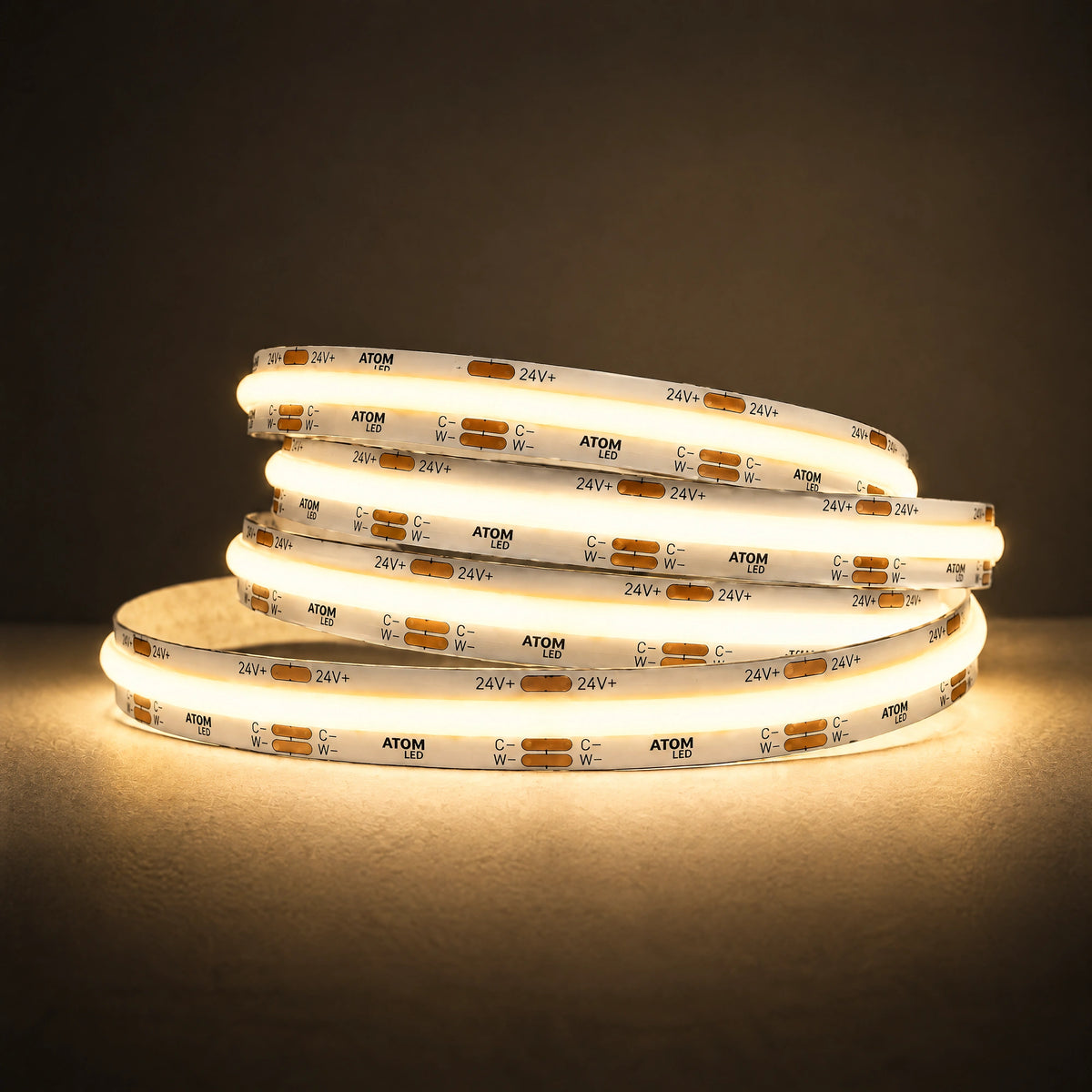
Tunable white strip is a strip with warm and cool white LEDs in one, which lets you set any tone from warm to cool, for people who want one installation to suit both daytime tasks and evening relaxing. Our tunable white COB strip covers 2700K to 6500K.
- Good for: living areas and home offices that change use through the day.
- Needs: a compatible CCT controller. A standard single colour dimmer will not change the colour. Browse our 12V 24V 48V controllers and choose one listed for CCT or tunable white.
- Not needed if: each space has one job, in which case a single warm or cool strip is simpler.
Tunable white costs more effort to set up, but one strip then covers every mood. Choose it for rooms that change role, and a single colour for rooms that do not.
How do you test a colour before you commit?
Try the light in the real space before you fit everything. Colour looks different against your walls, floors and existing bulbs.
- Get a short length of each colour you are considering.
- Hold it where it will be fixed, with your normal room lights on.
- Look at it in the evening as well as in daylight.
- Check how it makes food, skin and your walls look.
- Try it behind an opal cover, such as in an aluminium LED strip profile, because covers can soften the tone.
- Choose, then order the full length.
Test in the real room, at the real time of day, with the cover you plan to use. A ten-minute test avoids a costly re-fit.
What mistakes do people make when choosing LED strip colour?
- Choosing by name, not number: "cool white" means different things to different sellers. Check the Kelvin figure.
- Using cool white to relax: it can feel harsh in the evening.
- Mixing temperatures side by side: warm and cool strips in one view look mismatched.
- Ignoring CRI: a good colour temperature with poor CRI still looks dull.
- Buying tunable white without a controller: you need a compatible one to change the colour.
Build your lighting kit in 3 steps
Pick the parts below, plus a 24V driver sized for your strip length.
Frequently asked questions
Is 3000K warm white or cool white?
3000K is warm white. It is slightly crisper than 2700K but still golden. Most people find it works well in kitchens, bathrooms and hallways.
Which colour is best for a kitchen?
Use neutral white, about 3500K to 4000K, over the worktops for clear, natural food colours. Add warm white where you want a relaxed feel, such as around a dining area.
Is warm white strip dimmer than cool white?
Not by definition. Brightness is measured in lumens, not Kelvin. Cool white can look brighter, so compare the lumens per metre on the product page.
Can I switch from warm to cool white without changing the strip?
Only with tunable white strip and a compatible CCT controller. A single warm white or cool white strip cannot change colour.
What does CRI mean on LED strip lights?
CRI stands for Colour Rendering Index. It shows how naturally a light shows colours, on a scale up to 100. A CRI above 90 helps food, skin and fabrics look true.
Choose warm for rest, neutral to cool for work, and tunable white if one space does both. If you want help choosing a colour for your project, call 01952 370028 or email sales@atomled.co.uk.