

The best bedroom lighting ideas use three layers: a soft light overhead, a reading light at the bed, and a low warm glow for the evening. Choose warm white, about 2700K, put every layer on a dimmer, and avoid relying on one bright ceiling light. LED strip is the easiest way to add the low glow, because it tucks behind a headboard, under the bed or inside a wardrobe.
This guide gives lighting ideas for the bedroom in British homes, from low ceilings to box rooms. It starts with a simple plan, then looks at the main fixtures, 12 LED strip ideas, colour, dimming and power, and the mistakes to avoid.
Key takeaways
- Use three layers: ambient, task and accent, each on its own switch or dimmer.
- Choose warm white: about 2700K for most of the room, and 3000K to 4000K only at a mirror or wardrobe.
- Add a low glow: a strip behind the headboard or under the bed is the easiest accent.
- Dim everything: you rarely need full brightness in a bedroom.
- Keep wiring safe: use a reachable driver and ask an electrician for the mains side.
What are the three layers of bedroom lighting?
Bedroom lighting has three layers: ambient, task and accent. Ambient light fills the room, task light helps you read and dress, and accent light adds mood. The kitchen uses the same idea, as our guide to kitchen lighting ideas shows.
| Layer | Its job | Ideas |
|---|---|---|
| Ambient | Soft light for the whole room | Flush or semi-flush ceiling light, pendant, cove uplight |
| Task | Light for reading, dressing and getting ready | Bedside lamps or wall lights, mirror light, wardrobe light |
| Accent | Mood, depth and a gentle night glow | Headboard glow, under-bed strip, shelves, alcoves |
How do you plan bedroom lighting?
Good bedroom lighting ideas start with layers, and each layer should have its own switch or dimmer. A single ceiling light makes a flat, harsh room and casts shadows when you stand in front of the wardrobe. Layers let you read at night without waking a partner, then drop to a soft glow before sleep.
- Decide the use: reading, dressing, working or just sleeping.
- Add task light where you need it: a reading light at each side of the bed, a mirror light and a wardrobe light.
- Finish with accent light: a low strip or lamp that you can leave on dimly.
- Keep one colour family: warm white for most of the room.
- Control each layer, so you can run them alone or together.
Plan the layers first and the fittings second. The best bedroom lighting ideas keep three dimmable layers, and they feel calmer than one strong light.
Which light fixtures for bedrooms suit each layer?
Fixtures give the main light, and LED strip adds the soft layers around them. These fixtures suit different ceilings and bed layouts, and they all work with a strip layer. If you are collecting ideas for bedroom lights, start with the layer your room is missing.
- Flush or semi-flush ceiling lights: a good ambient choice for low ceilings, because they sit close to the ceiling.
- Pendants: a softer centrepiece for rooms with higher ceilings.
- Recessed downlights: neat and low-profile, but they need good spacing to avoid glare and dark patches.
- Wall lights: ideal beside the bed, and they save bedside table space in a box room.
- Bedside lamps: simple, flexible reading light.
- Floor lamps: a movable ambient or reading layer for corners.
Bedroom Lighting Ideas: 12 LED Strip Ideas
Each idea below uses LED strip in a channel, powered by a low-voltage driver. Pick two or three that suit your bedroom, or build all three layers over time.
1. Headboard Glow
Layer: Accent · Colour: 2700K
A warm strip behind the headboard washes the wall with a soft halo and makes the bed the focus of the room. It is the most popular bedroom strip idea, and it works well with a lamp or a pendant. A slim channel keeps it neat, such as our LED strip profiles.
- Colour: warm white, 2700K.
- Placement: along the top of the headboard, hidden from view.
- Control: a dimmer lets you lower it for sleep.

2. Under-Bed Night Glow
Layer: Accent · Colour: 2700K
A strip under the bed frame lights the floor gently, so you can cross the room at night without switching on a main light. It also makes a divan or platform bed look as if it floats.
- Placement: along the underside of the frame, facing the floor.
- Brightness: keep it low.
- Keep it clear: use a channel with a cover and keep the strip away from bedding.

3. Ceiling Cove Uplight
Layer: Ambient · Colour: 2700K to 3000K
A strip hidden in a ceiling cove, or behind coving, washes light across the ceiling and makes a low room feel taller. It gives soft ambient light with no visible fitting.
- Needs a gap: coving fixed hard to the ceiling leaves no room for the light.
- Aim up: face the strip at the ceiling, not into the room.
- Use a channel: it keeps the line straight.

4. Plaster-In Shadow Gap
Layer: Ambient · Colour: 3000K
A thin channel set into the ceiling or wall edge gives a crisp line of light with no visible fitting, which suits a clean, modern bedroom. It has to go in before the plasterer starts, so plan it early.
- Plan at first fix: it is much harder to add later.
- Match the width: the strip must fit the channel's internal width.
- Mask the slot: this keeps plaster out of the cover opening.

5. Bedside Shelf or Floating Shelf Strip
Layer: Task · Colour: 2700K to 3000K
A strip under a floating bedside shelf lights the shelf and the wall behind it, and replaces a lamp where space is tight. It works well in a box room.
- Placement: behind the front lip, so the strip is hidden.
- Use dot-free strip: dots can show on glossy surfaces.
- Dimming: put it on its own dimmer.

6. Inside the Wardrobe
Layer: Task · Colour: 3500K to 4000K
A strip inside a wardrobe lights your clothes and makes getting dressed easier. It is a small detail that makes a big difference, especially in a dark corner. Strip that can be cut anywhere, such as our free-cut COB strip, fits tight joinery.
- Control: a door sensor turns it on when you open the door.
- Colour: neutral white, so colours look true.
- Heat: use a channel and a low-wattage strip in an enclosed space.

7. Dressing Table and Mirror Light
Layer: Task · Colour: 3000K to 4000K
A strip around a mirror or under a shelf gives even light for getting ready. This is the one spot where a slightly crisper white helps. A cover avoids dots and glare, as our guide to the LED strip light diffuser explains.
- Colour: 3000K to 4000K, with a high CRI.
- Placement: around or behind the mirror.
- Cover: an opal cover gives a smooth line.

8. Alcove and Niche Lighting
Layer: Accent · Colour: 2700K
A strip inside an alcove or recess lights the space and adds depth to the wall. It suits chimney breast alcoves, which are common in British bedrooms.
- Placement: along the top inner edge.
- Hide the source: use a channel with a cover.
- Match the room: keep the colour warm and consistent.

9. TV Wall or Media Wall
Layer: Accent · Colour: 2700K to 4000K
A strip behind or around a wall-mounted TV adds a soft glow and reduces the contrast between the screen and a dark wall. It suits bedrooms with a feature TV wall.
- Placement: behind the TV or along a panel edge.
- Brightness: keep it dim.
- Colour: warm white feels cosy, and neutral white matches the screen.

10. Skirting Board Night Path
Layer: Accent · Colour: 2700K
A thin strip along the skirting board gives a low path of light to the door or bathroom. It is a safe, gentle night route for children and older people. Our guide to stair lights shows the same low-level approach on a staircase.
- Placement: along the top or bottom edge of the skirting, hidden.
- Control: a sensor switches it on when you step out of bed.
- Brightness: very low.

11. Colour-Changing Teen or Kids' Room
Layer: Accent · Colour: RGBW
RGB or RGBW strip lets a teenager switch between white and colours, with a remote or app. It suits gaming corners and shelves. Keep a warm white setting for bedtime.
- RGBW: it gives clean white as well as colours.
- Control: it needs a controller.
- Safety: keep the driver and wiring out of reach in a child's room.

12. Neon Sign Feature Wall
Layer: Accent · Colour: Warm white or colour
A neon-style sign over the bed or desk adds personality. Many people make their own from LED neon flex, which bends into letters and shapes.
- Placement: above the headboard or on a plain wall.
- Colour: warm white or a soft colour.
- Keep it small: it is an accent, not a main light.

Ideas 1 to 4 build the accent and ambient layers, and ideas 5 to 12 add task light and detail. Start with a headboard or under-bed glow, then add one task light.
What are the best bedroom light ideas for a ceiling?
For a bedroom ceiling, combine a soft general light with a gentle strip layer. A flush fitting gives the main light in a low room, and a cove or shadow gap adds a wash of light without a fitting. Ideas 3 and 4 above are the LED options.
- Low ceilings: use a flush fitting and uplight the ceiling, so the room feels taller.
- Higher ceilings: a pendant adds a centrepiece.
- Avoid a single bright light: dim it, and add lower sources.
What are the best lighting ideas for small bedrooms and box rooms?
Small bedrooms need light that adds no bulk. LED strip and wall lights save space, because they do not take up a bedside table or floor area. Ideas 1, 2 and 5 give the biggest lift in a box room.
- Use wall lights or a shelf strip: instead of bedside lamps.
- Light the ceiling or wall: a soft wash makes a small room feel bigger.
- Keep the colour consistent: one warm tone looks calmer.
How bright should bedroom lighting be?
A bedroom needs less light than a kitchen, and it should be easy to turn down. Spread the light across several soft sources instead of one bright bulb, and dim everything. Reading and dressing spots need more light than the rest of the room.
- Spread the light: several soft sources look better than one strong one.
- Dim everything: you rarely need full brightness.
- Task areas: put the brightest light where you read and dress.
- Strip lighting: a low glow only needs a low output strip.
What colour temperature is best for a bedroom?
Warm white, about 2700K, is the best choice for most of a bedroom. It is soft and relaxing in the evening. Use 3000K to 4000K only for a dressing mirror or wardrobe, where you want true colours. See our guide to warm white vs cool white LED strip lights.
- 2700K warm white: the main bedroom colour.
- 3000K to 4000K: a mirror or wardrobe, with a high CRI.
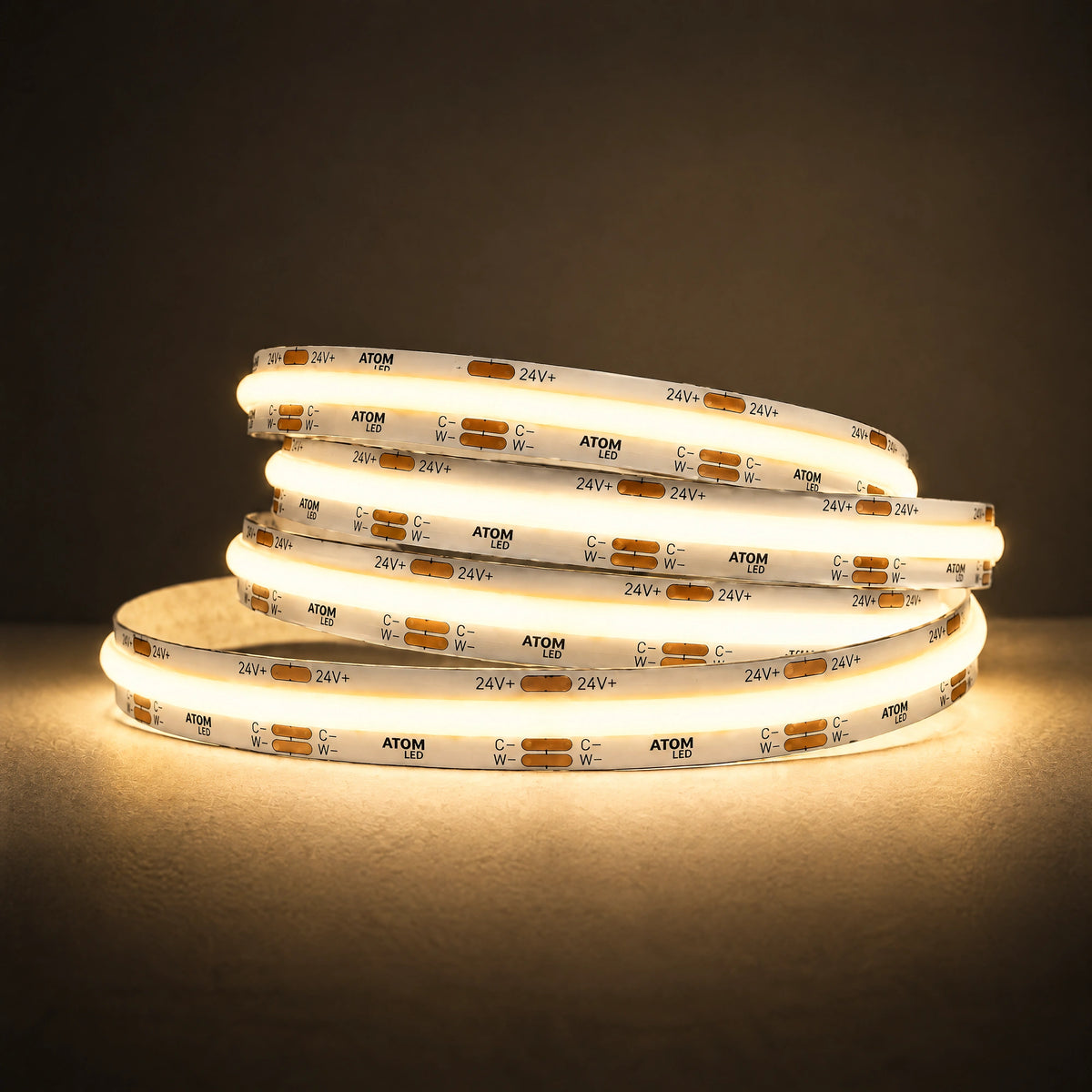
- Tunable white (CCT): Tunable white COB strip shifts from a brighter morning white to a warm evening glow on one strip.
- Keep it consistent: avoid mixing warm and cool strips in the same view.
How do you power, dim and control bedroom LED lighting?
Bedroom LED strip runs from a driver that converts mains power to low voltage, usually 24V. Choose a driver with 20 to 25 percent spare capacity, keep it where you can reach it, and add a dimmer or controller so you can lower the light.
- Match the voltage: the driver and the strip must be the same. See our guide to how to connect LED strips.
- Dimming: use a dimmable driver with a compatible wall dimmer, or a controller after a standard driver. See our guide to dimmable LED strip lights.
- Remote and app control: useful for bedside control without getting up. Browse 12V, 24V and 48V controllers.
- Hide the driver, but keep it reachable: a nearby cupboard works.
- Mains wiring: ask a qualified electrician.
- Never power coiled strip: the heat cannot escape.
Match the voltage, add a dimmer and keep the driver reachable. Let an electrician handle the mains side.
What mistakes do people make with bedroom lighting?
- Relying on one ceiling light: it makes the room flat and leaves task areas in shadow.
- Choosing cool white for the whole room: it can feel harsh at night.
- Making everything too bright: put every layer on a dimmer.
- Using strip with visible dots: hide the strip, or choose dot-free.
- No plan for the driver: decide where it goes before you start.
- Skipping the channel: a channel keeps the line straight and protects the strip.
Most bedroom lighting ideas fail when the plan is skipped. Choose the layers first, then the colour, then the driver.
Want help planning your bedroom lighting?
Send the ATOM LED team your measurements and layout. They will help with strip, channels and driver size.
Call 01952 370028 → · Email sales@atomled.co.uk
★ 4.82 from 994 reviews · Free UK delivery on 97% of products · Mon to Fri, 9am to 5pm
Frequently asked questions
How many lights does a bedroom need?
Think in layers. Most bedrooms need a soft general light, a reading light at the bed, and one low accent light. Add one layer at a time and see how the room feels.
Does a bedroom need a ceiling light?
Not always. Bedside lights, a floor lamp and an LED strip can light a bedroom well. A ceiling light helps with cleaning and tasks, so keep one on a dimmer if you can.
What colour light is best for a bedroom?
Warm white, about 2700K, suits most of the room. Use 3000K to 4000K for a dressing mirror or wardrobe, where you want true colours.
Are LED strip lights good for a bedroom?
Yes. A warm, dimmable strip behind the headboard or under the bed adds a soft glow without taking up space. Choose a dot-free strip and a dimmer.
Is LED strip lighting safe in a bedroom?
Low-voltage strip is safe when it is fitted correctly. Use a suitable driver, keep it reachable, never leave strip coiled while on, and ask a qualified electrician to do the mains wiring.
Can you put LED strip lights under a bed?
Yes. Fit the strip in a channel under the frame, facing the floor, and keep it clear of bedding. Use a low brightness, and put it on a dimmer or sensor for night use.
Pick two or three of these bedroom lighting ideas, choose warm dimmable strip and keep each layer on its own control. For help, call 01952 370028 (Monday to Friday, 9am to 5pm) or email sales@atomled.co.uk.