

The best living room lighting ideas layer ambient, task and accent light at different heights, instead of relying on one ceiling light. Aim for warm white at 2700K to 3000K, CRI 90 or above, and roughly 10 to 20 lumens per square foot, spread across several dimmable sources. LED strip is the easiest way to add the low and hidden layers.
This guide gives 12 living room lighting ideas arranged by height, a lumens table by room size, five ready-made scenes, and advice for open-plan rooms and renters. It skips the cove and shelf ideas we cover in our bedroom lighting ideas guide, so you get ideas you will not find in our other room guides.
Quick answer
- Layers: ambient, task and accent light at four heights: floor, seat, eye and ceiling.
- Colour: warm white, 2700K to 3000K, with CRI 90 or above.
- Brightness: about 110 to 215 lumens per square metre in total.
- Control: put every layer on a dimmer so one room gives five moods.
- Where LED strip helps: low glow, wall washes, backlighting and hidden ceiling light.
In this guide
- Which idea suits how you use the room?
- The best type of lighting
- How many lumens you need
- The four lighting heights
- Lamps and fittings
- Ceiling lighting ideas
- Wall lighting ideas
- 12 LED ideas by height
- Five lighting scenes
- Open-plan rooms
- Lighting without rewiring
- Which LED strip to choose
- Power and dimming
- Mistakes to avoid
- Shop the parts
- FAQ
Which of these living room lighting ideas suits how you use the room?
Match the idea to what you do most in the room. Watching TV needs a low backlight, reading needs seat-level light, and entertaining needs a bright ceiling layer plus accents. The table gives the fastest match, and the numbers point to the ideas below.
| How you use the room | Layer to prioritise | Start with idea |
|---|---|---|
| Watching TV | Low accent, dimmed | 5 and 1 |
| Reading | Seat-level task | 4 and 2 |
| Entertaining | Ceiling plus accent and colour | 9, 8 and 12 |
| Working from the sofa or desk | Brighter task light, 3500K to 4000K | 4 |
| Relaxing | Low warm accent | 1, 2 and 6 |
What type of lighting is best for a living room?
The best lighting for a living room is a layered mix of ambient, task and accent light, each on its own dimmer. Use a ceiling light or LED cove for general light, lamps for reading, and hidden LED strip for glow. One overhead light cannot do all three jobs.
- Ambient: fills the room, from a ceiling fitting or a hidden cove.
- Task: floor and table lamps beside seating and desks.
- Accent: LED strip, picture lights and wall lights for depth.
How many lumens does a living room need?
A living room needs roughly 10 to 20 lumens per square foot, which is about 110 to 215 lumens per square metre. This is a common lighting-design rule of thumb, not a regulation. Use the low end for relaxing rooms and the high end for reading or hobbies.
| Room size | Total lumens | Ambient 50% | Task 30% | Accent 20% |
|---|---|---|---|---|
| 10 m² (small) | 1,100 to 2,150 | 550 to 1,075 | 330 to 645 | 220 to 430 |
| 15 m² (average) | 1,600 to 3,200 | 800 to 1,600 | 480 to 960 | 320 to 640 |
| 20 m² (large) | 2,150 to 4,300 | 1,075 to 2,150 | 645 to 1,290 | 430 to 860 |
| 25 m² (open-plan) | 2,700 to 5,400 | 1,350 to 2,700 | 810 to 1,620 | 540 to 1,080 |
Worked example: a 15 m² room needs about 1,600 to 3,200 lumens, so the accent layer needs only 320 to 640. Check lumens per metre on the strip's product page, then run the strip at 10 to 40 percent on a dimmer. Buy strip for light quality and control, not raw brightness.
What are the four lighting heights in a living room?
The four heights are floor, seat, eye and ceiling level. Lighting every height makes a room feel balanced, because light arrives from above, from the sides and from below. A single ceiling light only covers the top.
| Height | Layer | Typical fittings | LED strip role |
|---|---|---|---|
| Floor | Accent | Floor lamps, uplighters | Underglow beneath furniture |
| Seat | Task | Table lamps, adjustable floor lamps | Soft edge light beside chairs |
| Eye | Accent | Wall lights, picture lights | Wall washes and backlighting |
| Ceiling | Ambient | Pendants, semi-flush, downlights | Hidden coves and halos |
Light at least three of the four heights. That is usually enough to make a living room feel layered.
Which lamps and fittings suit a living room?
Floor lamps and table lamps add light at seat and eye level, wall lights free up floor space, and a pendant or semi-flush light anchors the centre. Choose warm white bulbs at 2700K to 3000K, and put every source on a dimmer where you can.
- Floor lamps: beside sofas and armchairs for reading light.
- Table lamps: on sideboards and side tables, to bring light to eye level.
- Wall lights: a good choice in a small room, because they take no floor space.
- Pendants and downlights: keep pendants clear of heads and space downlights evenly.
ATOM does not sell lamps, wall lights or pendants, so buy those from a general lighting supplier. ATOM supplies the LED strip, channels and drivers that add the hidden layers around them.
What are the best living room ceiling lighting ideas?
Choose ceiling lights for a living room that give soft, even light and sit on a dimmer. A semi-flush light suits a low ceiling, a pendant suits a high one, and recessed downlights suit an even, modern look. Add a hidden LED halo for a gentle wash. See ideas 9 and 10 below.
- Fire rating: use fire-rated downlights where there is a room above.
- Keep it dimmable: the ceiling layer should drop right down in the evening.
- Do not rely on it alone: add lower sources so the ceiling light is not doing everything.
What are the best living room wall lighting ideas?
Wall lighting adds light at eye level, which makes a room feel warmer than ceiling light alone. Use wall lights beside the sofa for reading and picture lights over art. Use LED strip to wash a wall, frame a fireplace or backlight a media wall, as in ideas 2, 5, 6 and 7.
Living Room Lighting Ideas: 12 LED Ideas by Height
LED lighting in living room schemes works best when the strip is hidden and aimed at a surface, so you see a soft glow and not a row of dots. Each idea uses strip in a channel, powered by a low-voltage driver. The chips show the height and best colour.
1. Coffee Table Underglow
Height: Floor · Colour: 2700K
A strip under a coffee table lights the rug and makes the table look as if it hovers. The room feels lit from the floor up, not just from the ceiling.
- Placement: along the underside, set back from the edge.
- Brightness: about 10 to 20 percent is enough.

2. Behind-Sofa Wall Wash
Height: Seat to eye · Colour: 2700K
If the sofa floats away from the wall, a strip along the top of a low console behind it washes the wall with warm light. It gives the seating depth and a glow behind your head.
- Aim: up the wall, so only the glow shows.
- Cable: run it down the back of the console.

3. Bay Window Seat Glow
Height: Floor · Colour: 2700K
A strip under a bay window seat lights the floor and turns the bay into a feature after dark. Bays are common in UK Victorian and 1930s homes, and they are often the darkest corner at night.
- Placement: under the seat lip, facing the floor.
- Curtains: keep the strip clear of fabric and radiators.

4. Reading Corner Edge Light
Height: Seat · Colour: 3000K to 4000K
A short vertical strip in a wall corner beside an armchair gives a soft, glare-free edge of light. Pair it with a directional lamp for the page itself.
- Mount: in a corner profile so the line stays straight.
- Control: put it on its own dimmer.

5. Media Wall or TV Backlight
Height: Eye · Colour: 2700K to neutral
A strip behind a wall-mounted TV, or behind wooden slats on a media wall, lights the wall instead of the screen. This softens the contrast with a dark room. Many people find it easier on the eyes at night, although the evidence is mostly anecdotal.
- Colour: warm for cosy, neutral white to match the screen. Pick one.
- Placement: set the strip back from the edge so only the glow shows.
- Slats: leave a gap behind them so the light spreads.

6. Fireplace or Chimney Breast Surround
Height: Eye · Colour: 2700K
A strip on the outer edge of a fireplace surround, or under the mantel, frames the fire and adds a glow when it is unlit. Keep strip away from direct heat, because it is not made to sit next to a hot flue or firebox.
- Heat: follow the stove or fire maker's clearances.
- Colour: warm white sits well beside a real flame.

7. Large Art Halo
Height: Eye · Colour: 2700K to 3000K
A strip behind a large framed piece of art creates a floating halo and makes a plain wall a focal point. It adds light at eye level without a picture light.
- Set it back: so you see the glow, not the strip.
- Fixing: mount the strip and the frame separately.

8. Curtain Pelmet Wash
Height: Eye to ceiling · Colour: 2700K
A strip hidden in a pelmet or curtain box washes light down the curtains and makes the window wall glow. It adds height and softness in rooms with little daylight.
- Placement: behind the pelmet, aimed at the fabric.
- Fabric: pale curtains reflect more light, and the strip must not touch heavy fabric.

9. Ceiling Rose Halo
Height: Ceiling · Colour: 2700K
A ring of strip around a ceiling rose or pendant adds a halo to the focal light and spreads soft light across the ceiling. It suits the centre of a lounge or the space over a dining table.
- Shape: use flexible strip in a channel to follow the curve.
- Control: put the halo and the pendant on separate dimmers.

10. Tray Ceiling Double Cove
Height: Ceiling · Colour: 2700K
A recessed tray ceiling can take two strips: one in the tray edge and one in the central recess. This gives a layered ceiling glow in larger living rooms and new builds.
- Two circuits: control the tray edge and the centre separately.
- Plan at first fix: build the recess before plastering.

11. Open-Plan Zone Line
Height: Floor or ceiling · Colour: 2700K
In an open-plan room, a straight line of strip in the ceiling, or under a divider, marks where the lounge ends and the dining area begins. It tells the eye where each zone starts without a wall.
- Same colour: keep both zones the same warm white.
- Separate scenes: give each zone its own dimmer.

12. Colour Scenes for Film and Party Nights
Height: Any · Colour: RGBW
RGBW strip behind the TV or in a cove gives warm white every day and colour for parties or films. The white chip keeps everyday light clean. See our guide to LED strip lights with remote or smart control.
- Keep one warm scene: it is the one you will use most.
- Control: RGBW strip needs a controller, not just a dimmer.

Ideas 1 to 4 add low layers, ideas 5 to 8 add eye-level features, and ideas 9 to 12 work at the ceiling and across the room. Start with one low layer and one eye-level feature.
Parts for most living room builds
- Strip: Free-cut COB LED strip, cut anywhere so it fits your exact run.
- Channel: LED strip aluminium profiles for a straight, protected line.
- Driver: Triac dimmable LED drivers for control from a wall dimmer.
Check each product page for today's price, stock and run length.
What are the best lighting scenes for a living room?
The best scenes are presets you can recall in one tap: morning, day, evening, movie and entertaining. Each uses the same lights at different brightness and colour. These are starting points, so adjust them to your room.
| Scene | Layers on | Brightness | Colour |
|---|---|---|---|
| Morning and cleaning | Ceiling, task | 80 to 100% | 3000K to 4000K |
| Daytime | Ceiling, wall washes | 50 to 70% | 3000K |
| Evening relax | Accent, low ceiling | 20 to 40% | 2700K |
| Movie night | TV backlight and floor glow only | 5 to 15% | 2700K or neutral |
| Entertaining | Ceiling, accent, colour | 60 to 80% | 2700K, optional colour |
Switching scenes in one tap needs a controller or smart dimmers. Tunable white strip shifts colour on its own, and a smart controller stores each scene.
How do you light an open-plan living room?
Light an open-plan living room as separate zones, each with its own switch and dimmer. Lounge, TV and dining zones need different light at different times. Use one colour temperature across all zones, so the room still feels like one space. Our kitchen lighting ideas guide covers the kitchen end.
- Lounge: low lamps and a soft wall wash.
- TV zone: a backlight or media wall on its own dimmer.
- Dining or work zone: a pendant or task light, brighter than the lounge.
- Zone line: idea 11 marks the boundary without a wall.
Can you light a living room without rewiring?
Yes. Plug-in lamps, a plug-in driver for low-voltage strip, wireless dimmers and removable fixings add layers with no wall work. This suits renters and anyone avoiding building work. See our guide on whether LED strip lights stick to walls.
- Plug-in driver: low-voltage strip runs from a plug-in driver, with no mains cable work.
- Removable fixing: use clips or a channel with removable fixings if you rent.
- Wireless control: a remote or app dimmer avoids new wall switches.
- Start small: one layer first, then add more as the budget allows.
Which LED strip is best for a living room?
Dot-free COB strip in warm white, fitted in a channel with an opal cover, suits most living rooms. It gives one smooth line with no visible dots. Choose CRI 90 or above so fabrics, wood and skin look natural. See our guide to warm white vs cool white LED strip lights.
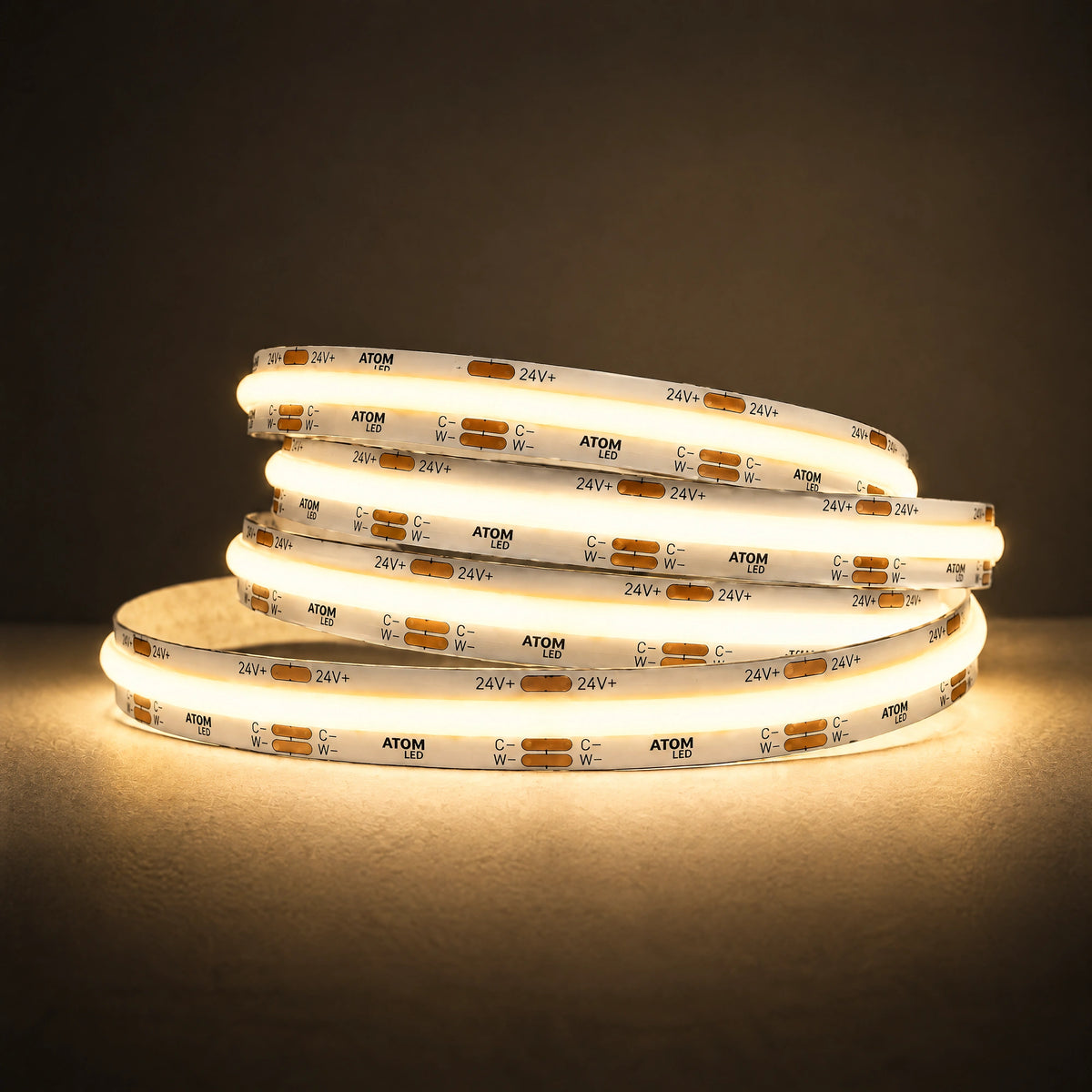
- Warm white, 2700K to 3000K: for most of the room.
- Tunable white (CCT): shifts from a daytime white to an evening glow on one run.
- RGBW: for colour scenes with a clean white.
- Cut to length: ATOM cuts strip to your measurements.
How do you power and dim living room LED lighting?
Living room LED strip runs from a low-voltage driver, usually 24V, sized with 20 to 25 percent spare capacity. For 12m of strip at 9W per metre, the load is 108W. Add 25 percent and you need at least 135W, so choose a 150W driver. See our guide to dimmable LED strip lights.
- Match the voltage: the driver and the strip must be the same.
- Hide the driver, but reach it: a nearby cupboard works.
- Mains wiring: ask a qualified electrician. A new circuit in England and Wales needs Part P notification.
What mistakes do people make with living room lighting?
- One ceiling light only: it flattens the room and glares on the TV.
- Lighting only the top: light floor, seat and eye level too.
- Aiming strip into the room: you see dots, not a glow.
- Mixing colour temperatures: warm and cool in one view looks uneven.
- Strip near heat: keep it clear of fires, flues and radiators.
- One switch for everything: layers need separate control.
Most of these come from planning one layer only. Choose three heights, one colour and a dimmer for each layer.
Shop the parts for each idea
Use this table to match each idea to a part. Give the ATOM team your measurements before you order.
| Idea | Part | Where to buy |
|---|---|---|
| Media wall or slat backlight (5) | Media wall lights | Media wall lights |
| Colour scenes (12) | RGBW strip | RGBW COB strip |
| Day to evening shift | Tunable white strip | Tunable white COB strip |
| Awkward measurements | Made-to-measure strip | Custom projects |
- Low-glow kit: warm white strip, slim channel and a dimmable driver for ideas 1 to 3.
- Movie-night kit: backlight strip, dimmable driver and a remote for idea 5.
Frequently asked questions
How many lumens do I need in a living room?
About 10 to 20 lumens per square foot, or 110 to 215 lumens per square metre. A 15 square metre living room needs roughly 1,600 to 3,200 lumens in total, spread across several dimmable sources.
What colour temperature is best for a living room?
Warm white, 2700K to 3000K, suits most living rooms and feels cosy in the evening. Use neutral white only at a task area or to match a TV screen.
What are the three layers of living room lighting?
Ambient light fills the room, task light helps you read or work, and accent light adds depth. Use all three, each on its own dimmer, at different heights.
What is the ideal type of lighting for a living room?
The ideal setup is several dimmable sources at different heights, in warm white. Combine a ceiling light, lamps and hidden LED strip, so you can change the mood from bright to relaxed.
What is the 5/7 light rule?
The 5/7 light rule is a design rule of thumb that a living room should have at least five to seven separate light sources. Mix ceiling, wall, floor, table and accent light. Sources vary on the exact number, so treat it as a guide, not a regulation.
What are the latest trends in living room lighting?
Hidden, indirect light is a recurring theme in current UK design guides, alongside layered lamps at lower heights and dimmable scenes. LED strip in coves, shelves and behind the TV fits this direction. Treat trends as ideas, not rules.
What lighting suits a modern living room?
Slim, minimal and hidden light suits a modern living room. A shadow gap, a cove, a TV backlight and a few simple lamps give a clean look with few visible fittings.
What is the best lighting for a small living room?
Slim, low-bulk lighting works best: wall lights, a floor lamp and hidden LED strip. They add light without using floor space, and a soft wall wash makes the room feel larger.
Should LED strip go behind the TV?
Yes. A soft, dimmed halo behind the TV reduces the contrast between the screen and a dark wall. Many people find it easier on the eyes at night, although the evidence is mostly anecdotal.
Can I add lighting to a living room without rewiring?
Yes. Plug-in lamps, a plug-in driver for low-voltage strip, wireless dimmers and removable fixings add layers with no wall work. This suits renters and anyone avoiding building work.
Need help planning your living room?
Send the ATOM LED team your room size and layout. They will help with strip, channels and driver size.
Call 01952 370028 → · Email sales@atomled.co.uk
Free UK delivery on 97% of products · Mon to Fri, 9am to 5pm
Light three heights, dim every layer and hide the strip, and your living room will suit every mood. Pick two or three of these living room lighting ideas, such as the behind-sofa wash or a media wall backlight, and build from there.